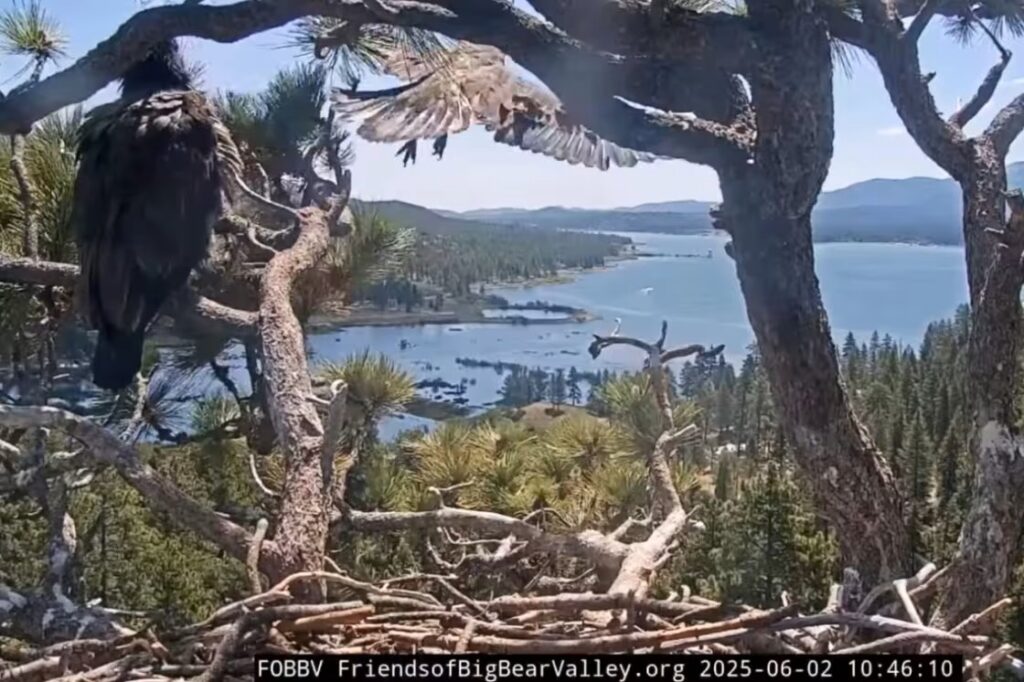
Nestled high in a Jeffrey pine overlooking Big Bear Lake, Southern California’s well-loved eagle family—Jackie and Shadow—have welcomed a fresh dose of excitement. Their two eaglets, Sunny and Gizmo, recently fledged, marking a major moment not just for the birds, but for the thousands who’ve watched their journey unfold via the live cam run by Friends of Big Bear Valley. This isn’t just a wildlife headline; it’s a quiet reminder that nature’s resilience and our simple fascination with it remain as powerful as ever.
Over the past few weeks, YouTube chatrooms and eagle-spotter forums buzzed with anticipation. Viewers saw Sunny balance at the nest’s outer edge, flapping her wings, testing the wind, hovering briefly over the rim—that tell-tale sign of readiness. According to NBC News, “After days of spreading her wings, even a mini lift-off for a few seconds, one of the Big Bear bald eaglets finally flew off the nest.” That eaglet was Sunny, who took her first true flight on June 2 at approximately 10:46 a.m., gliding into the blue sky in what can only be described as a breathtaking moment of transition.
Five days later, on June 7 at 8:27 a.m., it was little sister Gizmo’s turn. Gizmo took off from a perch adjacent to the large nest, hesitating for a moment before finally flying off into the sky. Cameras caught everything: Gizmo’s tentative launch and her father, Shadow, maintaining a watchful eye from a nearby branch.
Why these fledging moments matter
You might think a baby eagle flying off its nest is just something bird-lovers get excited about—but these events say a lot more. Bald eagles were once on the brink in California; the state recorded nesting pairs in only eight counties back in 1977. Thanks to protections, pesticide bans, and focused conservation, that number has now risen to more than forty. Every successful fledging contributes to that broader recovery story.
At a personal level, fledge day is a test of life: it proves the eaglets have grown strong enough to leave the nest. Once airborne, they’ll spend the next one to three months learning to hunt and navigate the sky, returning occasionally to eat, sleep, and learn from their parents. Their survival through this vulnerable period is a testament to the parents’ skill, the health of their habitat—and to the viewers who supported their journey by keeping watch.
What sets this story apart is the role of the live cam streaming 24/7. Since 2018, Friends of Big Bear Valley have streamed the nest around the clock. Their cameras have captured nesting attempts, hatchings, snowy storms, and heartbreaking early losses. This year, out of three eggs, two chicks survived and were named Sunny and Gizmo—names chosen by local schoolchildren from over 54,000 entries. That kind of community involvement turns wildlife into a shared experience, not just for local families, but for audiences around the globe.
It’s not just nostalgia or cuteness. Watching live—and seeing these birds grow hungry, clumsy, then graceful—forms a bond. That bond fuels interest in habitat protection, climate resilience, and the role of public lands. Suddenly, these birds aren’t background noise—they’re ambassadors for conservation.
Jackie and Shadow aren’t new to fame. First spotted nesting in 2012 and first televised in 2017, they’ve become icons of the valley’s wildlife revival. When harsh winter storms hit in 2023, dropping nearly 45 inches of snow, viewers watched anxiously as eggs were lost—making each success in subsequent seasons even sweeter.
For Sunny and Gizmo, fledging means more than freedom. It’s a proving ground. They’ll remain close to the nest while honing their skills under parental supervision. Over time, they’ll soar farther, eventually travelling hundreds of miles—potentially returning to breed and continue the cycle, maybe in this nest, maybe elsewhere.
Lessons beyond the nest
These fledging milestones remind us why wildlife matters. A big bird lifting into a clear sky becomes a metaphor for potential—both for that individual and for ecosystems. California’s bald eagle rebound—from near disappearance to thriving populations—shows what’s possible with policy, habitat protection, pollution control, and community engagement.
For viewers, that nest cam creates empathy. A young eagle’s first flight feels like our own achievements—new jobs, first day at school, even basic independence. Technology helps us witness and connect, shifting conservation from abstract to personal.
And the story isn’t over. Sunny and Gizmo may return to the nest at times, learning and resting. Jackie and Shadow will continue to protect the site—and hopefully come back next spring, ready to nest again.
There’s also a call to action. The eagles’ home is closed during nesting season to protect them—no trespassing and no disturbance are key. That respectful approach is part of the reason these fledging successes are possible. It’s a reminder that conservation often requires human restraint.
In simple terms
Watching Sunny and Gizmo take flight isn’t just a heartwarming nature story. It’s a snapshot of recovery, resilience, and reconnection. For a moment each morning, thousands tuned in to a live feed from Big Bear’s towering pine tree, cheered as these birds found their wings. And in doing so, they became part of something deeper—something rooted in land, sky, and shared curiosity.
Here’s to Sunny and Gizmo: may your flights be long, your journeys safe, and your skies wide.