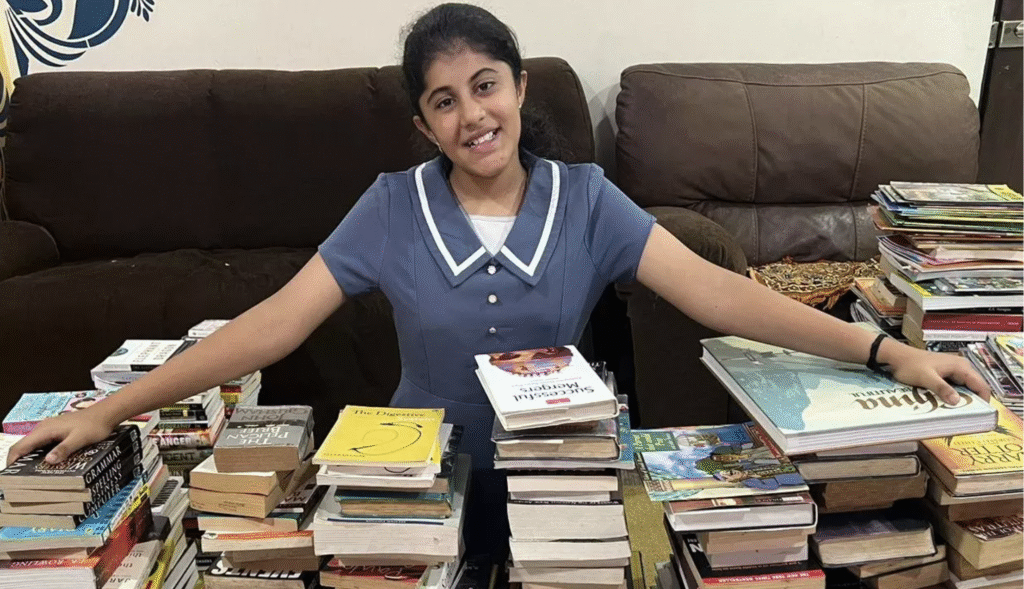
In a time when most 13-year-olds are balancing schoolwork, friends, and hobbies, Akarshana Sathish is quietly transforming communities across India—one library at a time. Based in Hyderabad, this teenager has already opened 21 libraries in just four years. Her mission is simple but powerful: to make books accessible to everyone, especially children and families who wouldn’t otherwise have them. Her journey is both heartwarming and quietly radical, and it’s still only just beginning.
It all started with one visit to a hospital
When Akarshana was nine years old, she visited MNJ Cancer Children’s Hospital in Hyderabad with her parents. While chatting with the young patients, she noticed they were bored and restless. Some asked her for colouring books. Others just wanted something to help them pass the long, uncomfortable hours. It struck her that these children, many of whom were fighting serious illnesses, had no access to books or any sort of creative outlet, per The Hans India.
“They wanted something to read or draw in,” she recalled. “They didn’t want to be just sitting there with nothing to do.”
That night, she began gathering books from her own shelf, then reached out to friends and neighbours. She returned to the hospital with a stack of reading material and helped set up a small library. It wasn’t fancy—just a few shelves of donated books—but it was enough to make a difference. Children who had been bored and anxious were suddenly reading, flipping through picture books, and even trying their hand at short stories. That library became the first of many.
Building a network of libraries across southern India
Today, Akarshana’s network spans three Indian states: Telangana, Andhra Pradesh, and Tamil Nadu. The locations she’s chosen reflect her core aim: to bring books to those who need them most. You’ll find her libraries in cancer wards, government hospitals, orphanages, police stations, railway training centres, schools in remote areas, and community halls. Each space is tailored to the people who use it.
“I always try to understand what kind of books people in each place would actually want to read,” she explained to The Better India. “For example, in a police station, I’ll include motivational books and novels for adults, but in hospitals, I bring more children’s books and comics”
The books she collects are in English, Hindi, and Telugu. Many are second-hand donations, carefully sorted, catalogued, and labelled. Over time, she’s developed a routine: once she identifies a potential site for a library, she organises book drives, works with local volunteers, and then oversees the installation herself.
Her father, Sathish Kumar, now plays a supportive role in handling transport and helping her manage logistics. But Akarshana is the one deciding where the libraries go, what books are included, and how each space is maintained.
“It has grown in a very big way from a small beginning,” her father said proudly. “She has taken this on with so much responsibility and clarity.”
Recognition—and scaling up her vision
In 2023, her work gained national attention. She received a donation of 2,000 books from Prime Minister Narendra Modi, who praised her for igniting a love of reading in places where books are often a luxury. That same year, she entered the India Book of Records as the youngest person in the country to set up libraries. But for Akarshana, the focus has never been on recognition.
“When someone tells me they read their first book because of the library, that’s what stays with me,” she said. “That’s what matters.”
One of her key partnerships has been with Seva Bharathi, an NGO that supports community development and education projects. With their help, she launched several of her libraries—including her 21st, which was opened at the Seva Bharathi Training Centre in Hyderabad. Local volunteers helped paint and furnish the space, and soon the shelves were filled with everything from encyclopaedias to fairy tales.
Akarshana’s work has also reached public transport. In collaboration with L&T Metro Rail Hyderabad and the National Book Trust, she’s helping to launch small lending libraries at 57 metro stations across the city. These mini-library kiosks will allow commuters to pick up a book at one station and return it at another.
“Even if someone reads five or ten pages on their commute instead of staring at their phone, it’s worth it,” she said. “It’s a small thing, but it can shift the way people spend their time.”
Encouraging others to follow her lead
Akarshana is still a student, managing her schoolwork alongside her growing responsibilities. She often spends her evenings sorting donations or replying to messages from people asking how they can help. She welcomes donations, especially books in Indian languages and children’s literature, and she’s keen to get more young people involved in her mission.
“I want kids my age to realise that we can do things like this,” she said. “You don’t need to wait until you’re older or richer or more powerful. You can start small.”
She also encourages people to set up micro-libraries in their own communities. A box of books in a waiting room, a bookshelf in a bus depot, or even a shared shelf in a local café can all become small hubs of learning and imagination. Her motto is straightforward: “Start reading. Start sharing. That’s where it begins.”
Her own favourite authors include Ruskin Bond and Sudha Murty, but she reads widely, everything from short stories to biographies. Her love of reading began when she was very young, and she credits books with shaping her confidence, curiosity, and imagination.
“Books give you a different kind of strength,” she said. “They teach you how to think and how to imagine something better.”
The future she’s building
At just 13, Akarshana has no plans of slowing down. She’s already thinking about the next phase of her work. Her goal? To establish 100 libraries across India before she finishes school. With each new space she creates, she’s not just handing out books—she’s helping children and adults alike discover a lifelong habit that could shape their future.
“When you put books in people’s hands, you’re giving them more than stories,” she said. “You’re giving them possibilities.”
Her journey is a reminder that you don’t need grand funding or fancy connections to make a difference. You need vision, consistency, and a deep belief that small things, like a well-loved storybook, can open up entire worlds. And sometimes, that’s all it takes to change a life.